The Nordic Countries can Collaborate More on Patients in Clinical Trials.
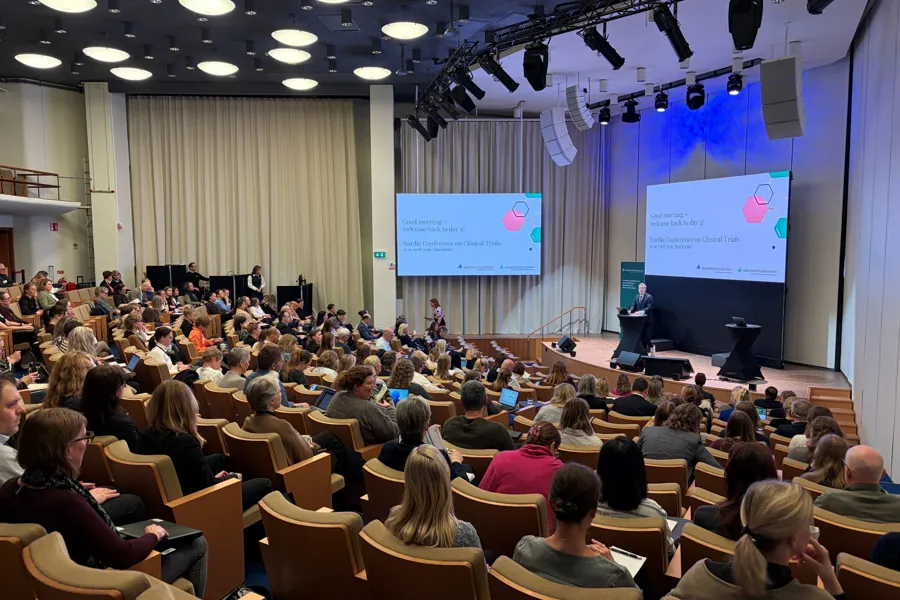
NorTrials was among the organisers when the Nordic Clinical Trial Conference 2026 brought together 250 industry representatives, clinicians, and researchers in Stockholm on 15th - 16th April.
Better with Nordic Opportunities than No Opportunities
- It is not optimal for small children with cancer to cross national borders to participate in clinical trials, but it is better that they have the opportunity in a neighbouring country than in a country far away.
This is stated by paediatric oncologist Karsten Nysom at the University of Copenhagen, who receives patients with rare cancers from across the Nordic region.
- I have had young patients from far north in Sweden. Their nearest treatment facility is often in a small town far north in the country, and the next closest is the university hospital in Stockholm. When there are no suitable clinical trials at these hospitals, they have to be sent all the way to me in Copenhagen. Then they are far from home, which is not optimal, but it is still better than if they had to be sent to the UK. So having these trials in the Nordics means that seriously ill young cancer patients can be treated not too far from home, says Nysom.
He reminds us that his patients are very ill and often have no other options. In the Nordics, there are nearly 30 million inhabitants in total, and it is better to have one study centre in the Nordics than none at all.
- Cancer in children is rare, but it is still the disease that causes the most deaths in children over one year old, so it is very meaningful to try to treat them - and to work towards improving treatment. We opened the phase 1 trial unit just over 10 years ago, he explains.
The centre in Copenhagen is part of a programme from NordForsk, established with support from the Nordic Council of Ministers.
- The goal is to prevent children from dying of cancer in the Nordic countries, says Nysom.
The challenge is to disseminate information about such opportunities for cross-border trials. If the trials can be made more decentralised, it would be an even greater advantage. In decentralised studies, some of the activities can be conducted at home with patients or at local treatment facilities - an obvious benefit for these children.
EU Project on Patient Participation Across Borders
Catharina Östberg is the head of Bayer's clinical trials in the Nordics, including the Baltics, and participates in the EU project EU-X-CT “Borders Should No Longer be Barriers.”
She states that cross-border participation is particularly relevant for rare diseases where the patient group is small, and for advanced therapies (ATMP) where expertise is centralised.
- I am proud to have been involved in drafting the document “Borders Should No Longer be Barriers”, and I recommend both clinicians and patients to read it if they are considering including patients in a trial in another Nordic country, or if they themselves are considering participating in a clinical trial across the border, says Östberg.
NorTrials Among the Organisers of the Conference
The Nordic Conference on Clinical Trials has traditionally been held every other year in one of the Nordic countries. Among the organising committee is Signe Fretland from NorTrials, along with leaders from the Nordic sister organisations, Danish Trial Nation and Swedish SweTrial. This year's themes were clinical trials in a digital world and strengthening Nordic collaboration.
- This conference is an excellent example of what we can achieve when we collaborate in the Nordics. As a bonus, through frequent meetings in the committee, we have also gotten to know each other better, and have a lower threshold for discussing common opportunities and challenges in other areas. Other Nordic meetings are also in the planning stages, says Fretland.

Photo: LMI
Ongoing Nordic Collaboration
Several Nordic initiatives have been launched to bring the Nordic healthcare services closer together, simplify patient flow, and increase the opportunities to include more patients in studies in the Nordics. NUHA (Nordic University Hospital Alliance) is an alliance between the five capital university hospitals aimed at collaboration in research, innovation, and patient care. Copenhagen and the Swedish region Skåne have established an infrastructure collaboration, and Finland, Estonia, Sweden, and Iceland are collaborating on patient referrals. Additionally, there is the paediatric network NordicPedMed and other discipline-specific networks in the Nordics that work together to ensure Nordic patients have the best possible access to studies.
Digital Tools and AI as Part of the Solution
New digital solutions increase the possibility of partially avoiding long travel distances to the study centre, but much work remains to find optimal solutions both technologically and legally. At the conference, attendees saw several good examples of the use of digital solutions for both patients and study centres. AI (artificial intelligence) has also made a significant entry into the daily life of clinical studies, being used to shorten processes, process data, and simplify work.
Fragmented Area
The Nordic countries share the same ambitions in clinical studies, but also many of the same challenges. There are many actors, many different databases, and solutions that do not communicate with each other.
How can we achieve collaboration that allows us to collectively solve some of the challenges? Signe Fretland, head of the coordinating unit at NorTrials, participated in a panel discussion, and Sigrun Margrethe Hjelle from NorCRIN gave a presentation – both on this topic. Fretland reminded us that even though Norway is a small country, Oslo University Hospital is one of the largest hospitals in Europe with around 24,000 employees and over 1.2 million patient treatments annually.
- In the new National Action Plan for Clinical Trials, we have a clear mandate from the Norwegian government to work more Nordic, says Fretland.
LMI has previously pointed out the opportunities that lie in Nordic collaboration, says Ina Dahlsveen, senior advisor at LMI.
- We support this approach, especially for rare diseases. Our members are already working in a Nordic context, but the public sector must also figure out how they can contribute to closer cooperation in the Nordics for the benefit of both patients and healthcare services in all countries, says Dahlsveen.
We Must Learn from Competitors – and We Have NUHA
Terje Ahlquist, Nordic Medical Director for Oncology at AstraZeneca, participated in panel discussions at the conference about digital tools and how we can strengthen the Nordics' attractiveness for clinical trials. He emphasised that one of the challenges at conferences like this is that all participants have different starting points and different expertise, and therefore do not necessarily discuss the same challenges and possible solutions.
- From my perspective, I am talking about drug trials in phases 1, 2, and 3. We were more attractive 10 years ago than we are today, partly due to the geopolitical situation. More investments are going to the USA and China, and I am more concerned about Nordic attractiveness now than I was five years ago. We have seen a 25% decrease in the number of trials since the peak year of 2013, and have thus lost many opportunities. The Nordics is a small region in the world, but in the Norwegian action plan for clinical trials, the authorities have set a goal to be among the top three in Europe. However, if we are to be among the best, we must look at how our competitors are doing it. Look to countries that are succeeding, like Germany and Spain. The healthcare system must implement the innovations that come out at the other end. And we must give clinicians incentives to conduct studies. Gen Z is not like Nysom and his colleagues, who give their private numbers to study patients and say they can call them anytime.
However, Ahlquist pointed out that certain centres in the Nordics, including in Oslo, stand out as unique in terms of patient inclusion and speed.
- We must understand what the model for success is. We need to delve into what works, where we excel, and why. We have NUHA. Let them figure out how we can work in the Nordics. We have much to gain from that hospital alliance, believes Ahlquist.
This page was translated from Norwegian using Optimizely auto-translate and reviewed by Ellen Johnsen.